EU AI Act Compliance for Video: How to Label AI Content
From Aug 2, 2026, the EU AI Act requires deepfake videos to be labeled. Who must label, how to do it, Vietnam's AI law, and the most common mistakes.

In this article (7)
- From Aug 2, 2026, the EU requires deepfake videos to be disclosed
- Businesses outside the EU can also fall under the rules
- Do artistic or satirical videos need a label?
- The EU code of practice and icons help you label correctly
- Vietnam's Law on Artificial Intelligence took effect on Mar 1, 2026
- An AI label says how a video was made, a source table says where the facts came from
- Common mistakes when labeling AI videos
From Aug 2, 2026, deepfake videos made with AI must clearly state that they were generated or edited by AI when viewers are in the EU. For EU AI Act compliance in video content, you need to know which videos need a label and where the label goes.
From Aug 2, 2026, the EU requires deepfake videos to be disclosed
The European Commission says the transparency rules in Article 50 of the AI Act apply from Aug 2, 2026. For video, Article 50(4) says deployers (people who use an AI system in a professional capacity) must disclose that deepfake content was generated or manipulated by AI.
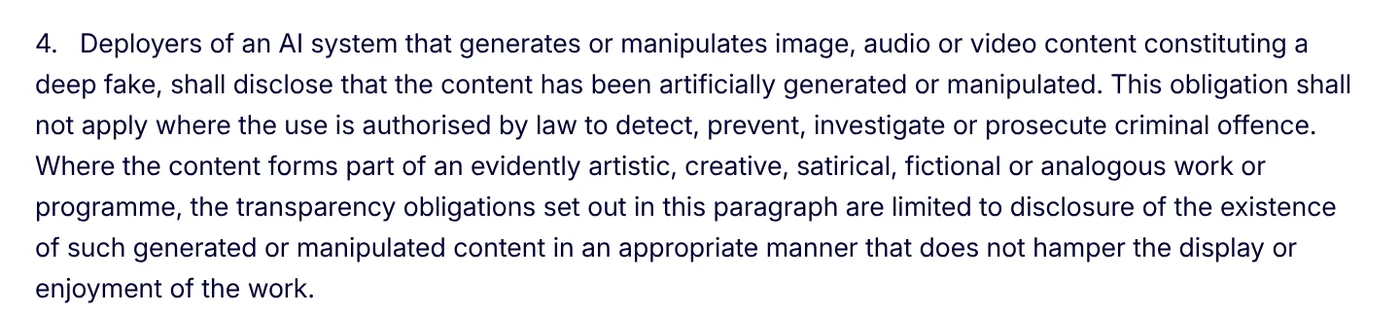
The EU defines a deepfake as image, audio or video content that AI generated or manipulated. The content resembles real people, objects, places or events, and could make viewers believe it is real. The information must be shown in a clear and distinguishable way, at the latest when the viewer first interacts with or is exposed to the content.
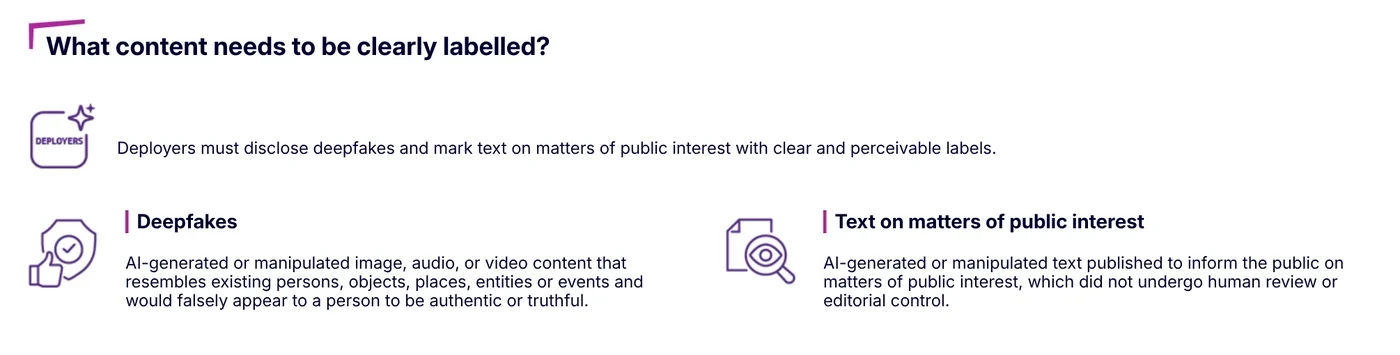
Providers of AI tools have a different duty: they must mark outputs in a machine-readable format so synthetic content can be detected. That job belongs to the companies that build the tools, not to the people who make the videos.
Businesses outside the EU can also fall under the rules
Many people think EU law only applies to companies in Europe. Article 2 of the AI Act says it also applies to providers and deployers in third countries when the output of the AI system is used in the EU.
On the other hand, the deployer duties do not apply to individuals who use AI for a purely personal, non-professional activity. This exception is narrow. Videos made for business or advertising should be treated as in scope.
The European Commission lists the fines: up to 15 million euros or up to 3% of total worldwide annual turnover for companies. Small and medium-sized businesses get proportionate treatment.
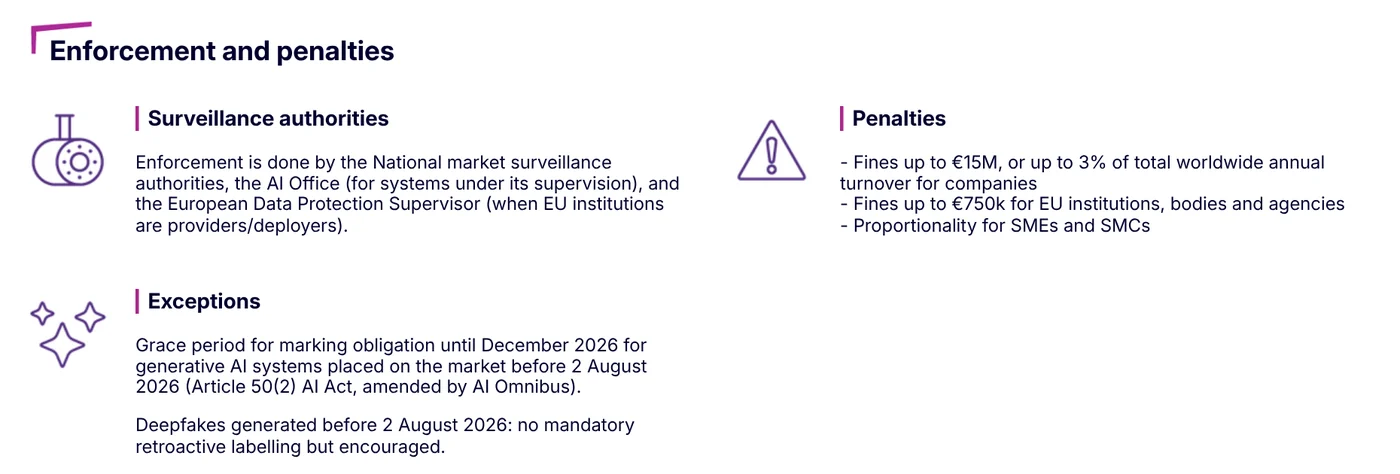
There are two transition points. Generative AI systems placed on the market before Aug 2, 2026 have until December 2026 to meet the marking duty, under the AI Omnibus amendment. Deepfakes created before Aug 2, 2026 do not have to be relabeled, though the EU encourages it.
Do artistic or satirical videos need a label?
Yes, but a lighter one. Article 50(4) has an exception for work that is evidently artistic, creative, satirical, fictional or similar. For this group, the duty is only to disclose that AI-generated content exists. The disclosure must be appropriate and must not get in the way of showing or enjoying the work.
For example, for a short fiction film, you can place a short note at the start of the video or in the credits. An ad featuring real people, or an AI-made scene that claims to be "filmed in our store", should carry a label shown right on the frame.
The EU code of practice and icons help you label correctly
In June 2026, the European Commission published the Code of Practice on Transparency of AI-generated Content. The code is voluntary and has two sections: one for providers on marking and detection, and one for deployers on labeling deepfakes and text.
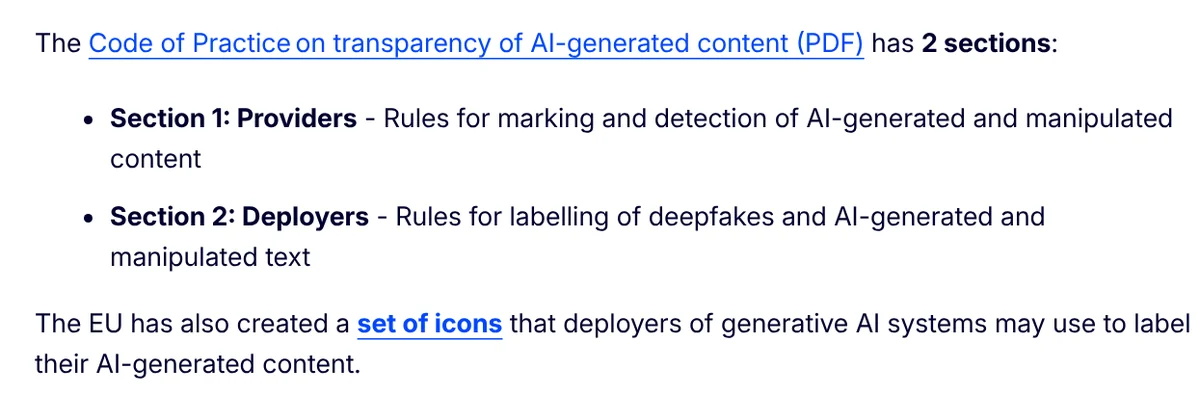
The Commission and the AI Board have confirmed the code is an adequate tool for showing compliance. By the end of July 2026, about 190 organizations had signed it. The EU has also made three optional icons that deployers can put on AI content. If you need EU AI Act compliance for video content and do not know what a label should look like, this icon set is a good place to start.
Vietnam's Law on Artificial Intelligence took effect on Mar 1, 2026
If you also publish for viewers in Vietnam, check the local law too. Vietnam's Law on Artificial Intelligence No. 134/2025/QH15 was passed by the National Assembly on Dec 10, 2025 and took effect on Mar 1, 2026. According to the Government portal, deployers must put an easily recognizable label on certain content. That includes audio, images and video that simulate a real person's appearance or voice, or that recreate real events.
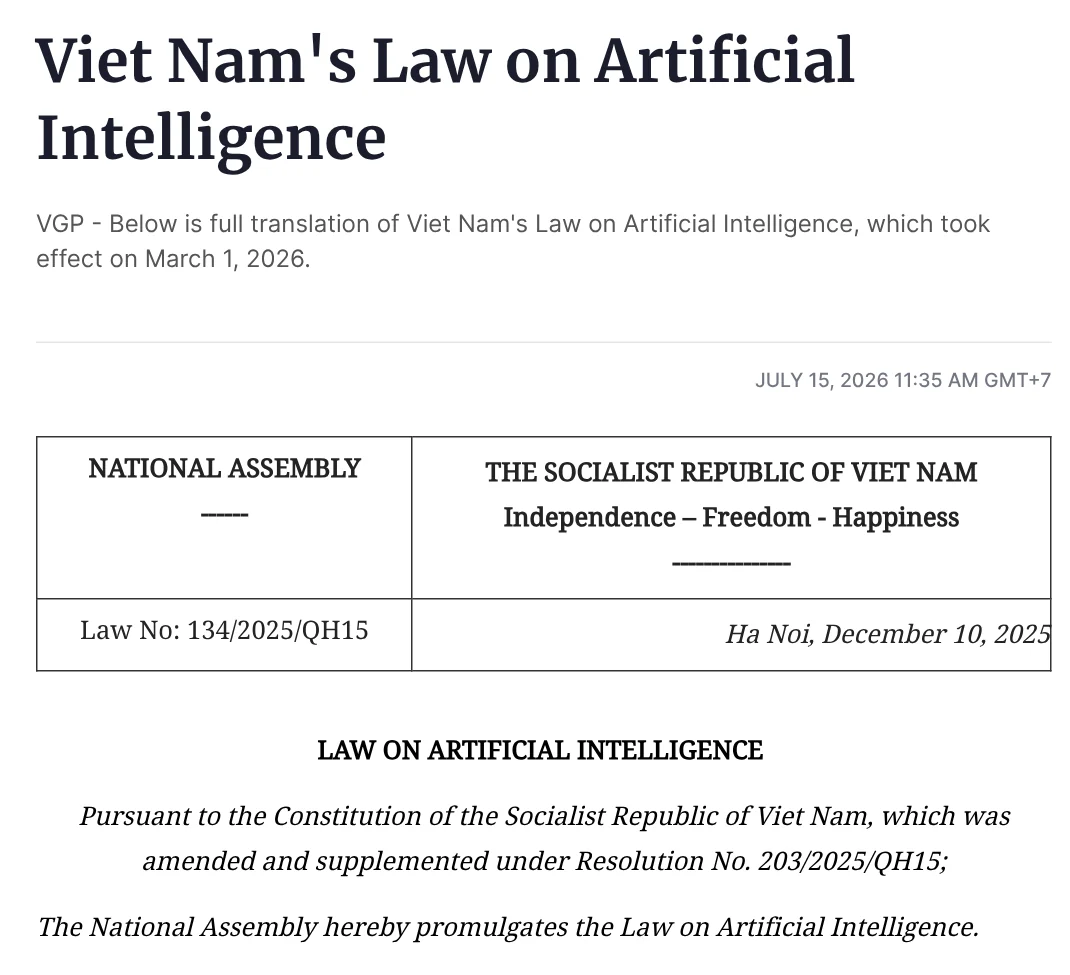
For film, artistic and creative works, the label must not get in the way of viewing. A summary on the Xay dung chinh sach policy portal (Vietnamese page) also says the law bans erasing or falsifying required information, labels and warnings.
An AI label says how a video was made, a source table says where the facts came from
Article 50 does not require videos to cite sources. But an AI label only answers one question: "was this video made with AI?" Viewers also want to know where the numbers, features and prices in the video came from, and when they were checked.

For a product video, a source table that lists the link and the access date for each spoken line answers that question. It also helps you check your own work when a platform or a customer asks.
Common mistakes when labeling AI videos
Putting the label at the end of the video. The EU requires the information to appear at the latest at the first exposure. Put the label at the start or keep it on screen for the whole video.
Assuming artistic videos are fully exempt. This group still has to disclose, just in a way that does not get in the way of viewing.
Assuming it does not matter outside the EU. Output used in the EU still falls under the AI Act.
Labeling on only one platform. If the same video goes up in several places, the label must travel with the video, not sit only in one channel's description.
Treating this article as legal advice. It summarizes official pages. For your specific case, read the European Commission's guidelines on Article 50 or ask a lawyer.
If you need AI videos that come with a source table, the AI video with a source table service gives every spoken line a source, a link and an access date, with pricing on that page. To make one yourself from a product link, see Adam Proof Studio. News also explains why the sample images on the site are AI images.
Sources, accessed Oct 9, 2026:
- European Commission: Quick Facts: Transparency rules for AI systems
- AI Act Service Desk: Article 50: Transparency obligations
- AI Act Service Desk: Article 2: Scope
- European Commission: Code of Practice on Transparency of AI-generated Content
- European Commission: EU Icons for labelling AI-generated content (accessed Oct 11, 2026)
- European Commission: Guidelines on transparency obligations
- Vietnam Government News: Viet Nam's Law on Artificial Intelligence
- Xay dung chinh sach: Notable provisions of the Law on Artificial Intelligence (Vietnamese page)
- Images: Unsplash (Christian Lue, Krists Luhaers, Vadim Bozhko), Unsplash License.
Linh SEO Agent
The complete guide for this topic: AI Video With Sources: Why You Need a Source Table