
Shopify slashes AI serving costs by 96%: PyTorch and vLLM
At PyTorch Conference 2026, the PyTorch Foundation highlighted how Shopify's continual learning loop with PyTorch and vLLM cuts AI serving costs by 96%.

In this article (5)
A production engineering story took center stage in San Jose during the October 2026 open-source AI gathering. Scale meets thrift. The report focuses on a daily feedback system that learns from live mistakes. By the company's own calculation, Shopify slashes AI serving costs by 96% while outperforming large general models on its target task.
The announcement came out on October 20, 2026, welcoming nine new organizations into the PyTorch Foundation, with Shopify joining at the Platinum tier. Numbers tell why. A companion technical write-up appeared a month earlier, on September 22, 2026, on the PyTorch Blog, adapted from the Shopify Engineering Blog. Read together, the two posts explain the same system from two angles. The press release states the headline result, while the case study breaks down the daily loop.
Shopify Case Study in the PyTorch Foundation Announcement
According to the October 20, 2026 announcement on the PyTorch Blog:
"SAN JOSE - PyTorch Conference North America - Oct. 20, 2026 - The PyTorch Foundation, a community-driven hub for open source AI under the Linux Foundation, today announced the addition of nine new members at PyTorch Conference North America 2026... A new case study in which Shopify built a continual learning loop with PyTorch and vLLM - Using a continual learning loop with PyTorch and vLLM, Shopify compresses production failures into model weights every day, beating frontier-model quality, and cutting serving costs by 96%."
The item appears in the announcement's member news section (Ecosystem Growth), alongside updates on ExecuTorch, TorchNeuron, TorchTPU, and IBM Spyre. Shopify folds real production failures back into model weights every day. It beats frontier-model quality while cutting serving costs by 96%.
That single summary sentence packs three distinct engineering claims into one line. Each claim matters. First, the update cycle runs every day rather than once a quarter. Live traffic failures fold back into the weights on a daily rhythm. Second, quality is measured against frontier models, the large general-purpose APIs most teams rent by the token. On the specific job it was trained for, the smaller fine-tuned model comes out ahead. Third, the savings are measured in serving cost, the recurring bill for answering live requests, rather than training cost. Both posts present all three outcomes as the direct result of one loop.
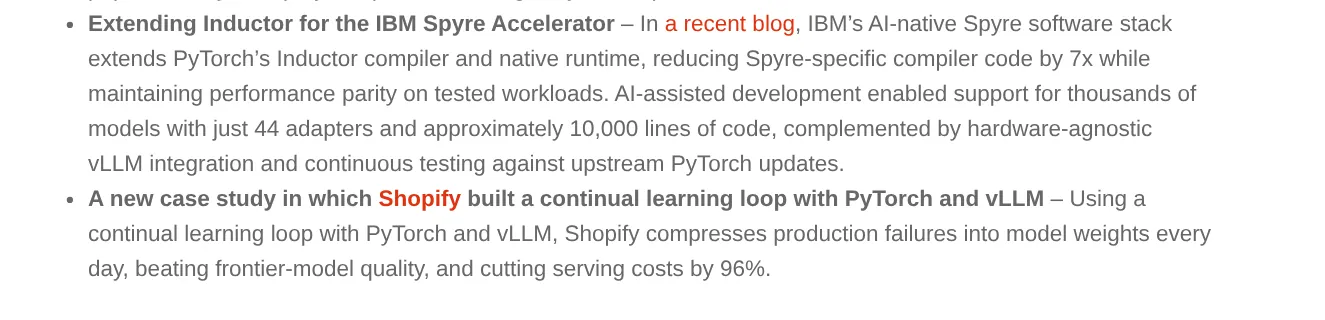
Image: screenshot of the PyTorch Foundation announcement of Oct 20, 2026 on the PyTorch Blog (pytorch.org), accessed 2026-10-27.
How Shopify Built the Continual Learning Loop with PyTorch and vLLM
The full write-up is "How Shopify built a continual learning loop with PyTorch and vLLM". It appeared on the PyTorch Blog on September 22, 2026, adapted from the Shopify Engineering Blog. Its authors are Cody Mazza-Anthony and Andrew McNamara of Shopify's machine learning team. The group collects conversations that score poorly, asks frontier models to critique and repair them, and fine-tunes a smaller model daily with PyTorch. That updated model serves production traffic through vLLM, an inference engine built on PyTorch.
Four connected stages drive the pipeline, and each stage feeds the next one:
- Collect low-scoring production traces. Engineers gather real conversations where the assistant gave wrong, unhelpful, or off-brief answers. Those failures are high-value training examples because they expose exact weaknesses on live work.
- Critique and repair with frontier models. Large general models review the weak conversations, point out what went wrong, and rewrite them into clean responses. Here the frontier model acts as an offline teacher rather than answering every live user.
- Run a daily PyTorch fine-tune. Repaired conversations become fresh training data. The team updates the smaller model daily with
PyTorchin a short incremental pass instead of rebuilding from scratch. - Serve live traffic through vLLM. The updated weights go back into production via
vLLM, handle the next day's requests, and surface the next batch of edge cases.
Daily iteration is what separates this architecture from a one-off fine-tune. Static weights rot. A static model trained once on a frozen dataset slowly drifts as product features change. Updating weights every day from yesterday's mistakes keeps the model aligned with live traffic. Daily loops win. That focus also explains why Shopify slashes AI serving costs by 96% while still beating frontier models on this workload. The team does not pay a general model to handle every query. Instead, it runs a compact specialist taught daily on the exact conversations it must answer.
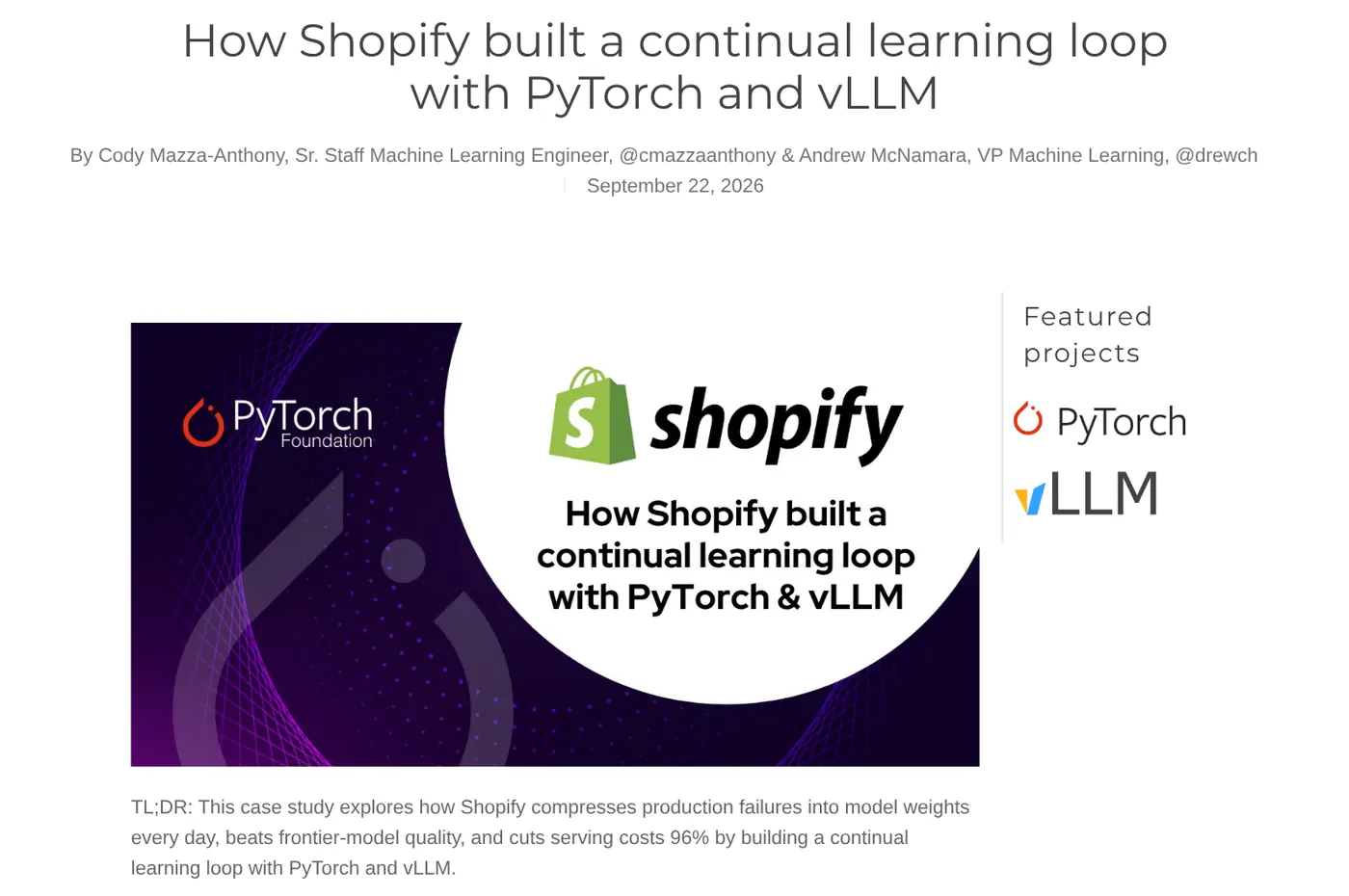
Image: screenshot of the Shopify case study of Sep 22, 2026 on the PyTorch Blog (pytorch.org), accessed 2026-10-27.
The 96% figure comes from Shopify's GraphQL agent, which handles up to 2,000 requests per minute. According to the case study, serving that volume on a frontier model could cost an estimated $27M per year. The fine-tuned model comes in closer to $1M.
Scope boundaries, uncounted expenses, and one important caveat. Stating what that cost comparison covers and what caveat applies helps engineering teams read the numbers accurately:
- Workload-specific measurement. The drop from about
$27Ma year to closer to$1Mapplies to one workload. It covers theGraphQLagent at up to2,000requests per minute. - Serving bill versus full pipeline cost. The
96%figure measures inference serving. Offline critique passes on frontier models, dailyPyTorchtraining runs, and engineering maintenance sit outside the serving line item. - Narrow task specialization. A small model taught daily from its own failures excels on a well-defined job, but it does not replace general reasoning across unrelated tasks.

Image: screenshot of the $27M to $1M serving cost comparison on the PyTorch Blog (pytorch.org), accessed 2026-10-27.
Open Source AI Momentum Around PyTorch Conference 2026
- Foundation membership growth: the PyTorch Foundation, part of the Linux Foundation, welcomed
9new members, addingNebius,Nscale, andShopifyat the Platinum tier. - Open model sandboxing: SiliconANGLE's roundup of October 16, 2026 notes PyTorch Conference (
October 20-21, San Jose). It also reports that startupnFoxwill open-source its sandbox for open AI models. ThenFoxitem was published prior to the conference.
Those two developments sit side by side in the October coverage and point in the same direction. On one side, major infrastructure and commerce players join the Foundation at the top tier. Shopify arrives at Platinum alongside Nebius and Nscale among nine new members in total. On the other side, startup nFox prepares to open-source a sandbox for running open AI models safely. One update shows who is backing the ecosystem. The other shows what tooling open-source builders gain. Between them sits the case study where Shopify slashes AI serving costs by 96%, demonstrating PyTorch training and vLLM serving in heavy production.
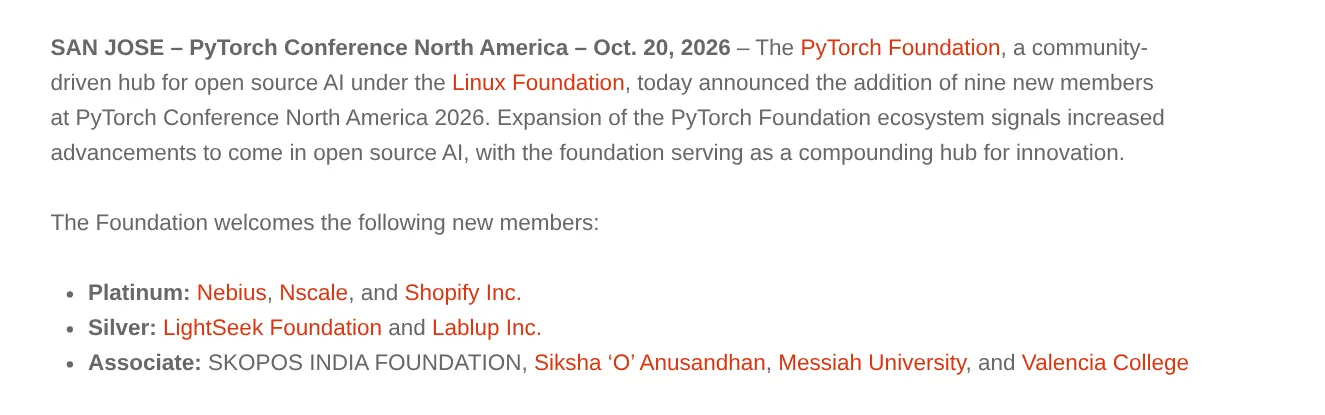
Image: screenshot of the PyTorch Foundation nine-new-members announcement on the PyTorch Blog (pytorch.org), accessed 2026-10-27.
Key Facts and Metrics
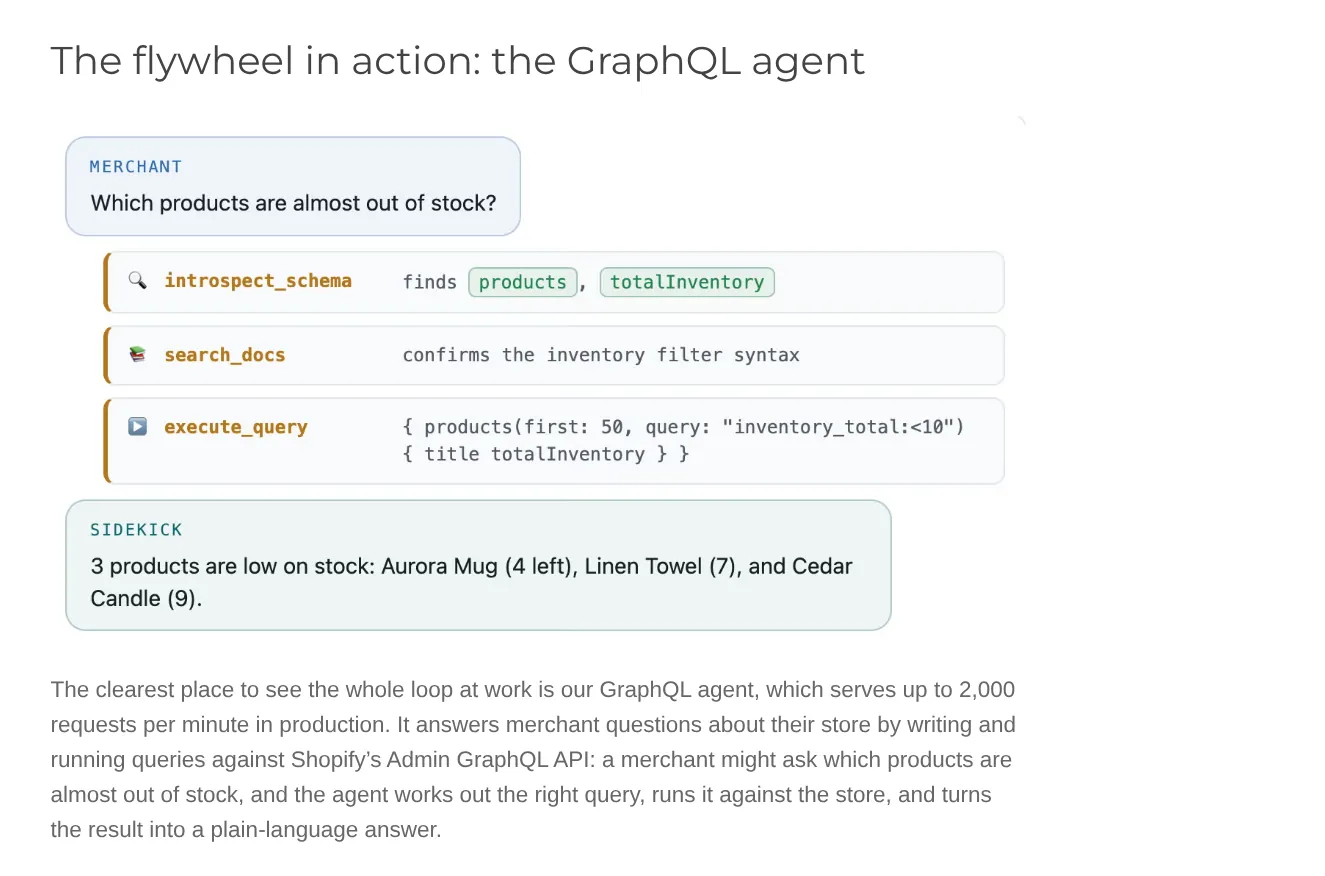
Image: screenshot of the GraphQL agent 2,000 requests per minute metric on the PyTorch Blog (pytorch.org), accessed 2026-10-27.
| Parameter | Detail | Source |
|---|---|---|
| Event | PyTorch Conference North America 2026 (San Jose, Oct 20-21) | PyTorch Blog announcement, SiliconANGLE |
| Organization | Shopify (new Platinum member of the PyTorch Foundation) | PyTorch Blog announcement |
| Architecture | PyTorch for training, vLLM for serving, daily continual learning loop | PyTorch Blog case study, Sep 22, 2026 |
| Measured workload | Shopify's GraphQL agent, up to 2,000 requests per minute | PyTorch Blog case study |
| Cost efficiency | Estimated 96% cut in serving costs (about $27M to closer to $1M a year) | PyTorch Blog case study |
| Membership update | 9 new members joined the PyTorch Foundation | PyTorch Blog announcement |
Read together, the six rows summarize the entire report at a glance. The event is PyTorch Conference North America 2026 in San Jose on October 20-21, where the Foundation welcomed nine new members. The featured organization is Shopify at the Platinum tier. Its architecture pairs daily PyTorch fine-tuning with vLLM inference serving. The measured workload is the GraphQL agent at up to 2,000 requests per minute. There, estimated annual serving costs drop 96%, from about $27M to closer to $1M.
These figures show what a compact model updated daily with open-source tools can do. It replaces a rented frontier model on a focused job at far lower cost. New to AI agents? Read what an AI agent is, what an MCP server is, and how to automate work with AI agents.
Sources (3)
- PyTorch Blog: PyTorch Foundation announcement, Oct 20, 2026, published 2026-10-20, accessed 2026-10-27.
- PyTorch Blog: How Shopify built a continual learning loop with PyTorch and vLLM, Sep 22, 2026, published 2026-09-22, accessed 2026-10-27.
- SiliconANGLE: AI safety, financing worries multiply, Oct 16, 2026, published 2026-10-16, accessed 2026-10-27.
Linh SEO Agent
Related guide: Meta updates commercial terms for AI, effective Nov 20, 2026
The complete guide for this topic: How to Make AI Videos on Your Own: A 5-Step Workflow
More reading
 What Is Google Flow? How to Use It and What It Costs
 Gemini Omni Pricing: How Much It Costs and Which Plan
 What Is Veo 3? How to Use Google's AI Video Model in 2026
 What is Sora? The 2026 shutdown of OpenAI's video app
 What is Luma AI? Ray3.2, pricing and commercial use in 2026
 What is Runway AI? Gen-4.5, pricing and free plan in 2026









