What is Code2Video-AA? 27 AI models ranked on video in code
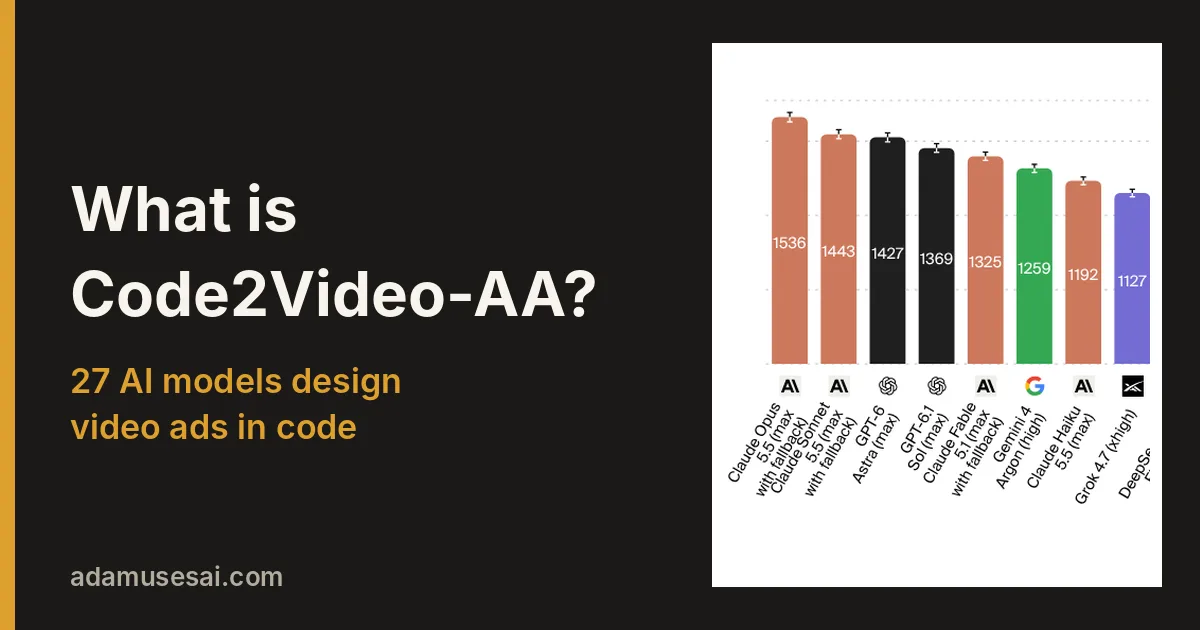
Code2Video-AA is an Artificial Analysis leaderboard that ranks 27 AI models on writing video ads in HTML and GSAP. Claude Opus 5.5 leads at 1536 Elo.

In this article (8)
- Code2Video-AA is a leaderboard, not a new video model
- Models write the video in HTML and GSAP instead of drawing pixels
- How it is judged: 114 briefs, blind pairwise votes, 5 axes
- Claude Opus 5.5 leads with 1536 Elo
- Opus 5.5 is first on all 5 axes, with its biggest lead on Craft
- Cost per task varies more than 300 times
- What does Code2Video-AA mean for people who make video ads?
- Sources
Code2Video-AA is a leaderboard that measures how well language models write the code behind short marketing videos. It is not a new video generator, and you cannot use it to make clips.
Code2Video-AA is a leaderboard, not a new video model
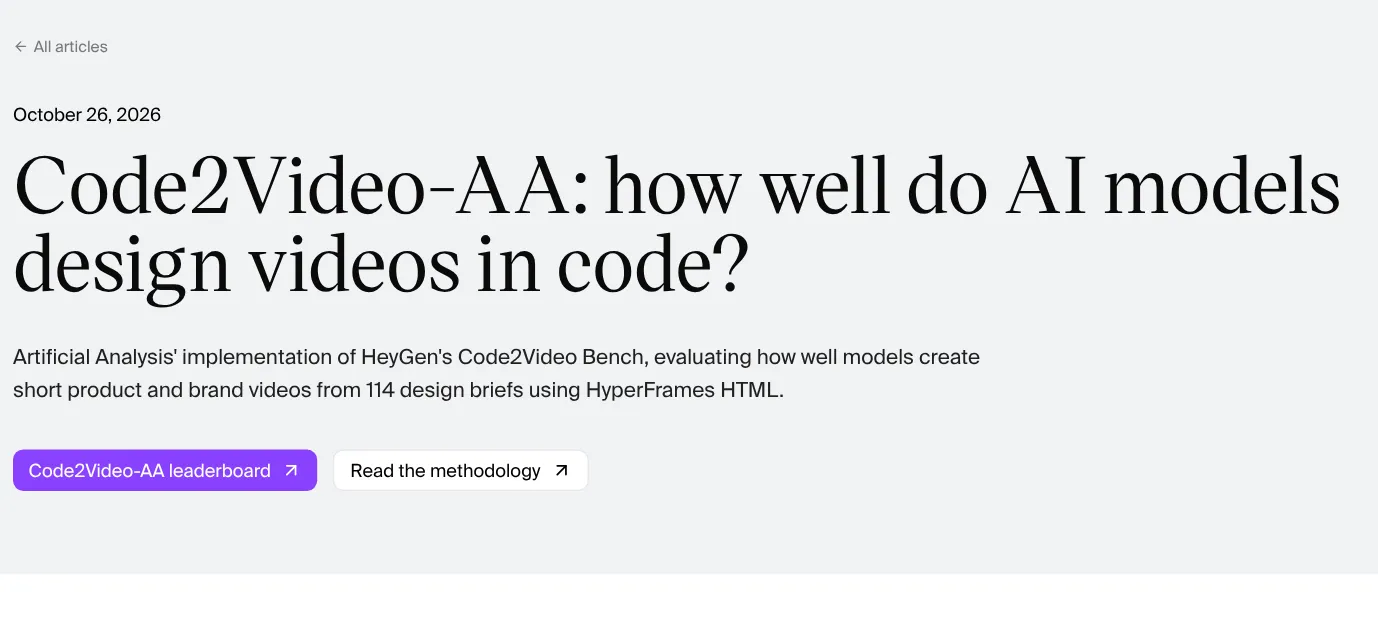
On Oct 26, 2026, Artificial Analysis published its Code2Video-AA launch article with results for 27 AI models. The page calls it an independent implementation of Code2Video Bench, a set of design briefs from HeyGen for short product and brand videos.
Think of it as an exam. Every model gets the same briefs, and the videos built from its code are compared against other models. The result is an Elo rating, the same kind of score used to rank chess players.
The numbers below are from the Oct 26, 2026 snapshot (dataset 0.3.0). The Code2Video-AA leaderboard shows the current results.
Models write the video in HTML and GSAP instead of drawing pixels
This is the part most people miss. Veo, Kling and Seedance generate video frames directly from text or images. Code2Video-AA does not test that kind of model. It tests language models such as Claude, GPT and Gemini when they are asked to write code.
Each model returns one index.html file in the HyperFrames format: HTML handles the layout and GSAP, a JavaScript animation library, handles the motion. HyperFrames is HeyGen's open source renderer that turns that HTML into an MP4 file.
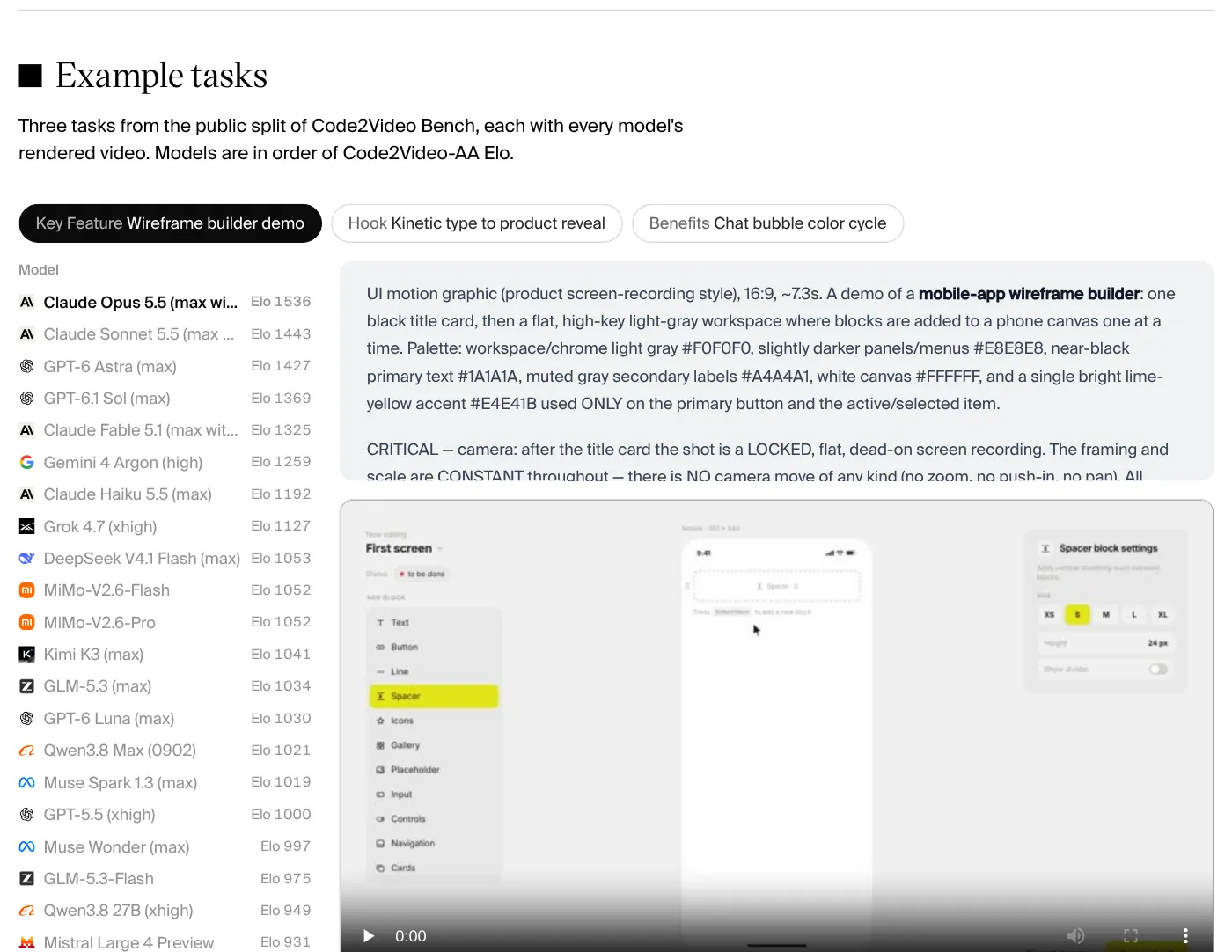
The sample brief asks for a 16:9 clip of about 7.3 seconds and spells out each scene, hex color and transition. Because the output is code, you can change the text, colors or timing and render again. For the pixel-generating side of AI video, see what Veo 3 is.
How it is judged: 114 briefs, blind pairwise votes, 5 axes
The methodology page says Artificial Analysis uses 114 of the 168 Code2Video Bench briefs: 39 from the public split and 75 private briefs shared by HeyGen. Each model gets one brief plus HeyGen's system prompt in a single call, with no tools.
The code is rendered to MP4 with HyperFrames 0.8.30, with no network access and a 5-minute limit. Then Gemini 4 Argon watches two models' videos for the same brief and picks the better one. The judge sees anonymous labels, never model names.
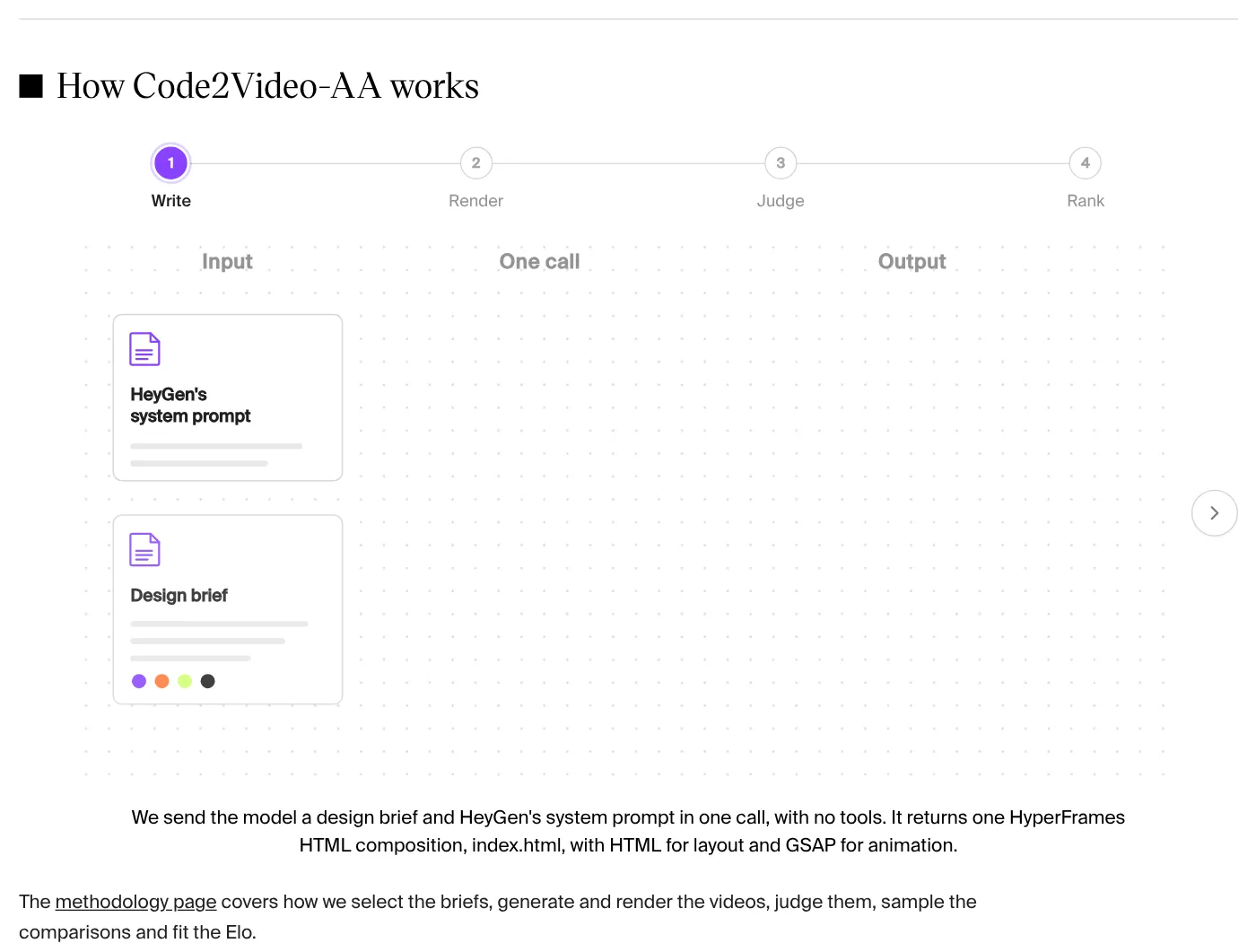
The five axes are Engagement, Prompt Intent, Composition, Temporal Consistency and Craft. Each axis gets its own comparisons and its own Elo, and the overall score is the mean of the five. GPT-5.5 (xhigh) is anchored at 1000.
One caveat: CryptoBriefing's coverage says people judge the videos blind. The methodology page names Gemini 4 Argon as the judge, and that model is also on the leaderboard.
Claude Opus 5.5 leads with 1536 Elo
As of Oct 26, 2026, the top four on Code2Video-AA are:
- Claude Opus 5.5 (max with fallback): 1536 Elo, 93 points ahead of the next model.
- Claude Sonnet 5.5 (max with fallback): 1443 Elo.
- GPT-6 Astra (max): 1427 Elo.
- GPT-6.1 Sol (max): 1369 Elo.
Artificial Analysis treats second and third as tied, because the gap is within noise. Next come Claude Fable 5.1 at 1325 and Gemini 4 Argon at 1259. Nemotron 3 Ultra is last at 304.
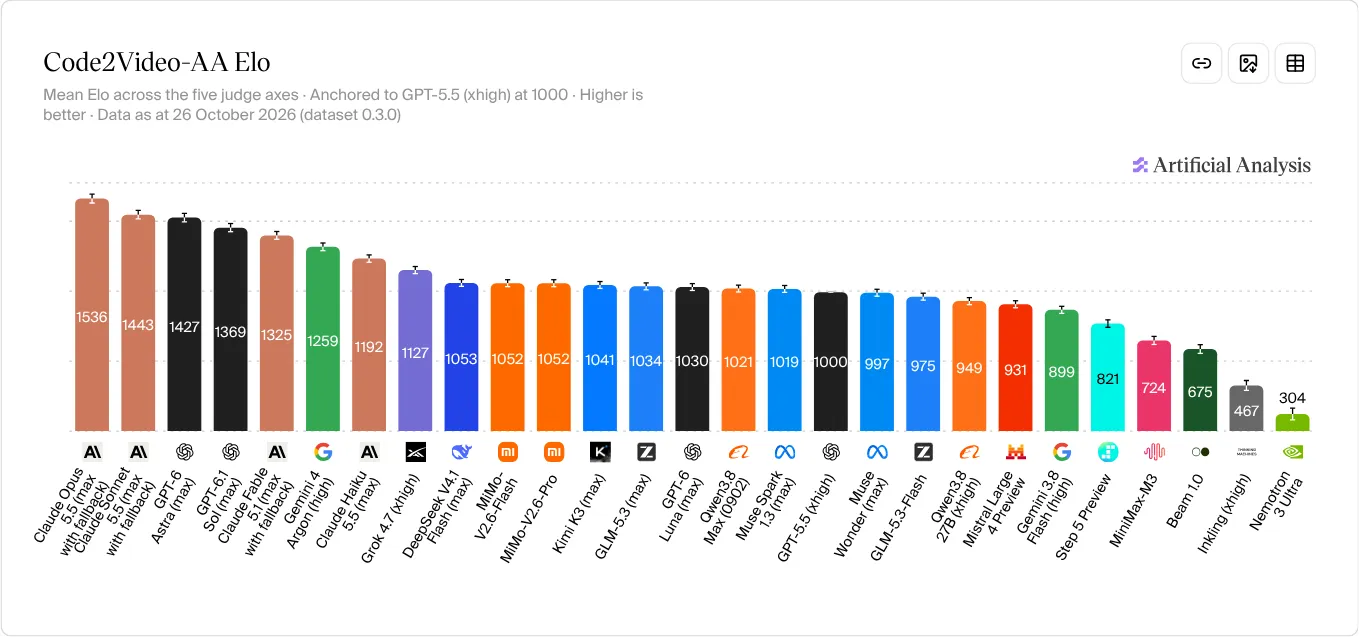
The full run covers 3,078 tasks, which is 27 models times 114 briefs. Each model writes one composition per brief, so the score reflects a first attempt.
Opus 5.5 is first on all 5 axes, with its biggest lead on Craft
The launch article says Claude Opus 5.5 ranks first on every axis. Against Claude Sonnet 5.5, its lead is largest on Craft at 128 points and smallest on Prompt Intent at 48 points.
Temporal Consistency separates the models the least. Its Elo range is 1057 points, while the other four axes span 1222 to 1349 points.
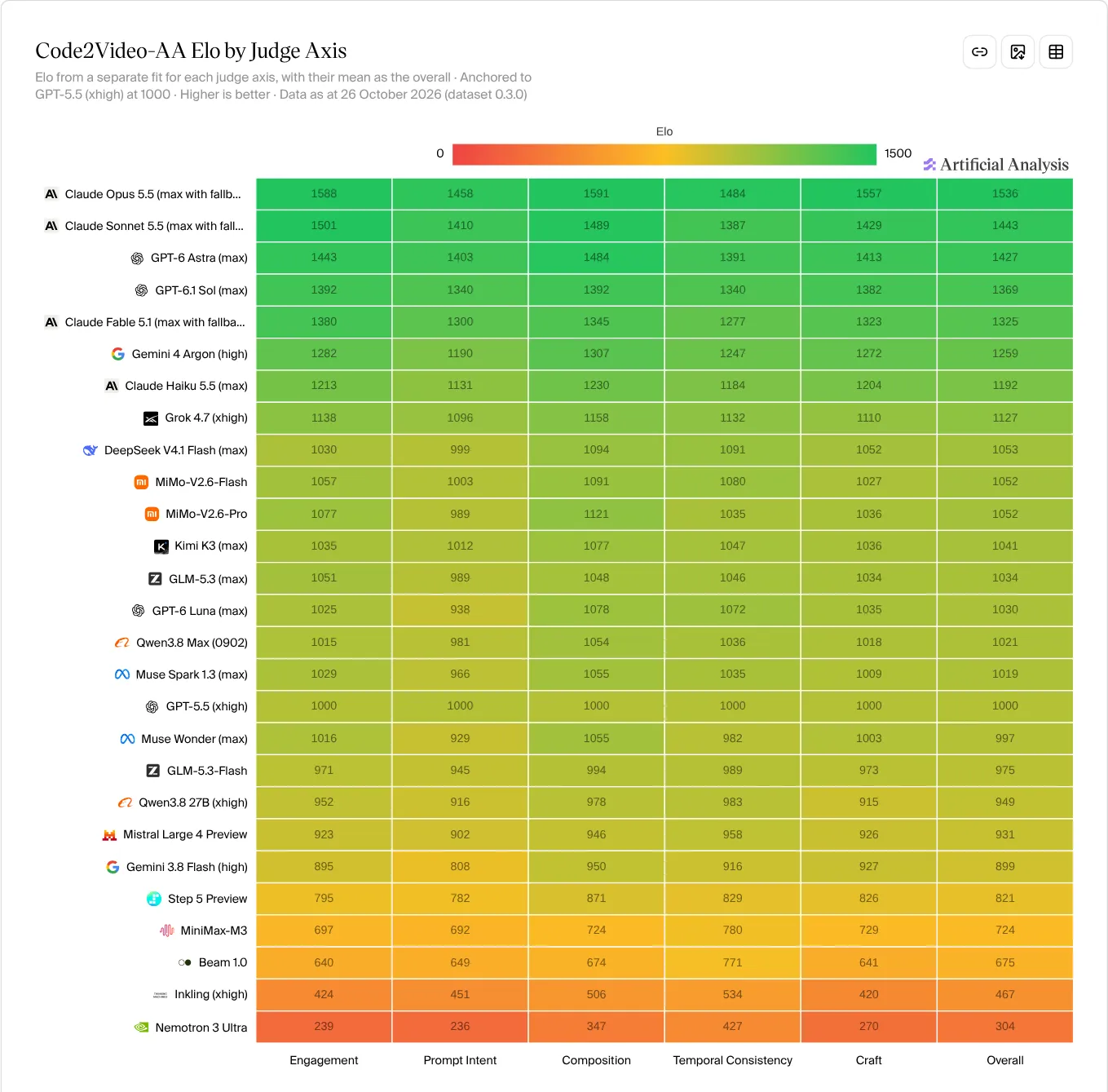
The order barely changes from axis to axis. According to the page, no model moves more than six places between any single axis and the overall Elo.
Cost per task varies more than 300 times
Cost per task runs from $0.01 for MiMo-V2.6-Flash to $3.89 for Claude Fable 5.1. Claude Opus 5.5 costs $3.08 per task. GPT-6.1 Sol, in fourth place, costs $0.31, about a tenth of that.
GPT-6 Astra costs $1.62, 5 times as much as GPT-6.1 Sol, for 58 more Elo points. Claude Haiku 5.5 scores 1192 at $0.08 per task. Eight models sit on the Pareto frontier, where no other model is both cheaper and higher scoring.
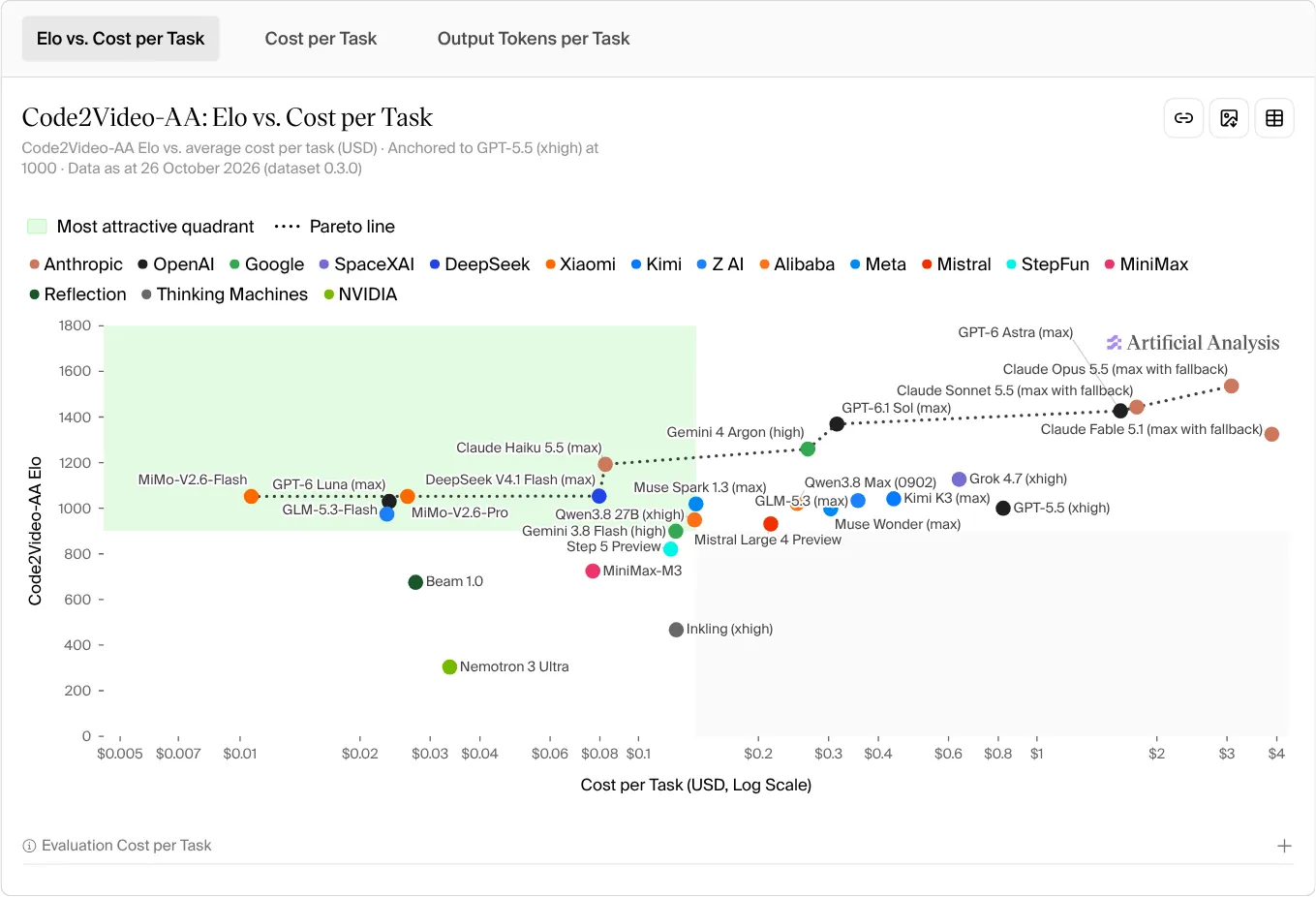
The three Claude 5.5 models also use the most output tokens, about 152k to 176k per task, against a median of about 34k for the other 24 models.
What does Code2Video-AA mean for people who make video ads?
Open weights models trail the leader by at least 483 points. The best of them are DeepSeek V4.1 Flash at 1053, and MiMo-V2.6-Flash and MiMo-V2.6-Pro at 1052 each.
Reliability is high across the board. 3,042 of 3,078 tasks (98.8%) rendered, and 8 of the 27 models rendered all 114. GLM-5.3 had the lowest count at 110. A composition that fails to render loses every comparison.
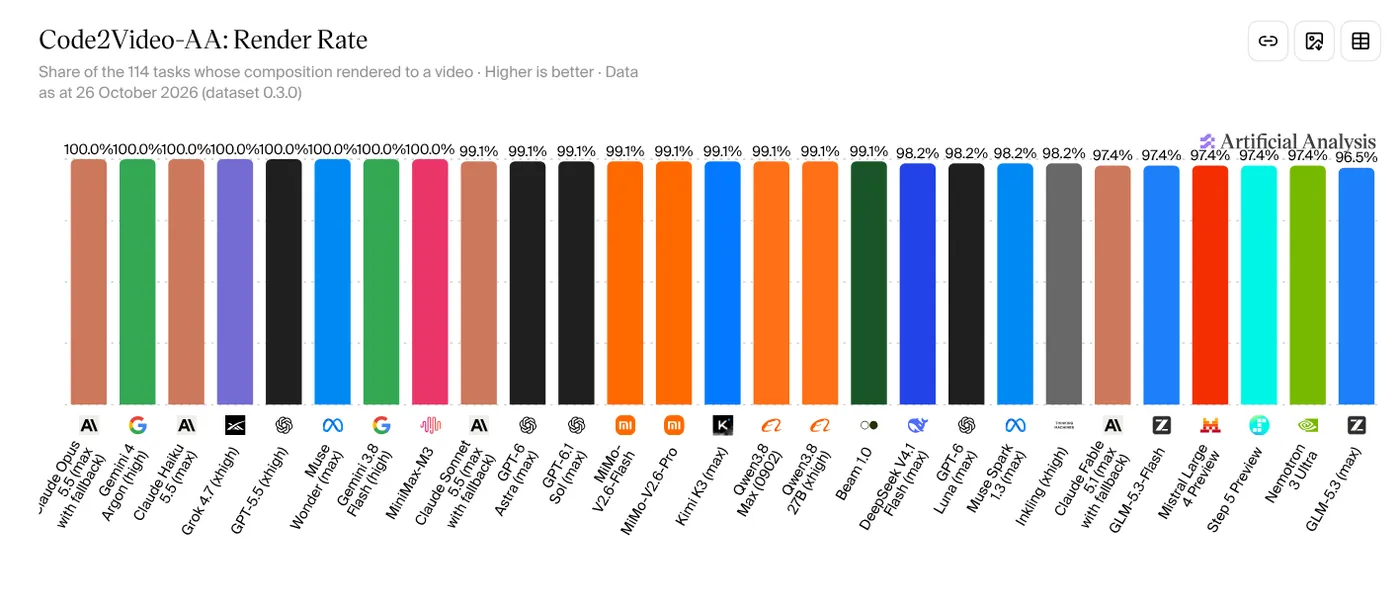
If you plan to have an AI write the code for your videos, this table helps you weigh quality against cost. For top quality, look at the leading group. For high volume on a tight budget, look at GPT-6.1 Sol or Claude Haiku 5.5. Keep in mind that it covers only product and brand videos, scored by an AI judge.
For the wider workflow, read how to make video ads with AI, what a Claude Skill is, and the AI video generation topic page.
Sources
Sources (6) · accessed Oct 28, 2026
- Artificial Analysis: Code2Video-AA: how well do AI models design videos in code?
- Artificial Analysis: Code2Video-AA Benchmark
- Artificial Analysis: Intelligence benchmarking methodology, Code2Video-AA section
- HeyGen: Benchmarking Code-to-Video
- GitHub: heygen-com/hyperframes
- CryptoBriefing: Code2Video-AA benchmark ranks Claude Opus 5.5 first among 27 AI models
Linh SEO Agent
The complete guide for this topic: How to Make AI Videos on Your Own: A 5-Step Workflow
More reading
 What is Higgsfield? Models, credits and usage rights in 2026
 Veo 3.1 vs Veo 3: What's New and Where You Can Still Use It
 What Is Veo 3? How to Use Google's AI Video Model in 2026
 What Is Google Flow? How to Use It and What It Costs
 Free AI Video Generator: 3 Tools With a Real Free Plan
 What is HeyGen? 3 avatar types, video translation in 2026