74% plan to use AI assistants, only 15% let agents pay
74% of US shoppers plan to use AI assistants this holiday season, but only 15% will let an agent pay. That trust gap will decide who wins the season.


In this article (5)
A new holiday retail survey finds that 74% of US shoppers plan to use AI assistants during the 2026 shopping season. Yet only 15% will allow an AI agent to use their payment information, even with a final human review step before checkout. Without that review step, willingness to let an agent pay drops to 10%. That 59-point gap between product discovery and payment is the defining story of holiday commerce this year.
Talkdesk published its 2026 AI Holiday Shopping Survey on 2026-11-04. Fielded by research firm Centiment in September 2026, the study surveyed 1,048 US adult online holiday shoppers aged 18 and older. Researchers also interviewed 312 retail decision-makers at US companies with 50 or more employees that already use AI in daily operations.
What this survey measures
The Talkdesk study examines three practical questions for holiday commerce. First, how do consumers use AI tools while shopping for gifts and deals? Second, where do buyers draw the line on autonomous checkout? Third, how fast are retail organizations building infrastructure for customer-side and store-side agents?

Keep two methodological boundaries in mind as you read the numbers. First, every respondent is based in the United States. The data measures US holiday shopping behavior rather than global or Southeast Asian averages. Second, the retail sample only includes companies that already use AI in their business. That means the 89% figure for retailers preparing to receive customer shopping agents reflects active AI adopters rather than every brick-and-mortar store.
| Survey group in the Talkdesk release (2026-11-04) | Share | Practical takeaway |
|---|---|---|
| US shoppers who plan to use AI assistants this season | 74% | Shoppers use AI to hunt deals, brainstorm gifts, and compare |
| Shoppers open to buying an unfamiliar brand via AI tip | 49% | AI discovery gives smaller brands a shot at the cart |
| Shoppers who let an agent pay with a prior review step | 15% | Even with human approval, most keep payment manual |
| Shoppers who let an agent pay with no review step | 10% | Full autonomous checkout remains a small niche |
| AI-using retailers preparing for customer shopping agents | 89% | Stores are building agent-ready catalog and order flows |
| AI-using retailers deploying agents in customer service | 93% | Automated support handles peak holiday ticket volume |
| Shoppers who want clear disclosure when AI is involved | 77% | Transparency is a baseline expectation for buyers |
| Retailers that do not fully disclose their use of AI | 37% | Undisclosed automation creates a major trust deficit |
| Shoppers calling for stronger AI regulations | 74% | Buyers want firm rules on privacy and pricing fairness |
| Retailers reporting an AI error in the past 12 months | 58% | Operational mistakes are already happening in live stores |
Shoppers plan to use AI to search, not to pay
Consumers welcome AI at the top of the shopping funnel. The 74% who plan to use AI assistants rely on citation-backed answer engines like those covered in What is Perplexity. Many also use multimodal models explained in What is Gemini 3 to compare specifications, summarize reviews, and spot promotions. Because the shopper still clicks the buy button, search assistance carries almost no financial risk.

Notably, 49% of surveyed shoppers say they would purchase from an unfamiliar brand based on an AI recommendation. Independent merchants can win those buyers by presenting clear product data and clean visuals created with tools like Create Images with ChatGPT. AI search can put a newcomer right alongside established retail giants. As Michael Klein, who leads retail product marketing at Talkdesk, noted in the release, consumer trust has become the ultimate currency.
Why do wallets stay closed when an agent asks for card details? Among the 74% of shoppers demanding stronger AI rules, 55% worry about unauthorized personal data collection. Another 41% worry about undisclosed paid placement inside AI recommendations, and 41% fear dynamic pricing that charges them more than another buyer. Meanwhile, 77% of consumers want to know whenever AI is part of their shopping journey, yet 37% of retailers admit they do not fully disclose their AI use.
Retailers move faster than customers
On the merchant side, automation is moving much faster than consumer comfort. While shoppers hesitate to let agents pay, 89% of surveyed retailers are preparing for agents that shop on a customer's behalf. In addition, 93% are deploying AI agents in holiday customer service, and 51% plan to use AI agents for returns, refunds, and exchanges.

The survey's error statistics explain why shoppers remain cautious. Over the past 12 months, 58% of AI-using retailers experienced AI errors, and 29% of that group lost customers as a direct result. Specifically, 33% faced customer complaints about AI interactions, and 31% reported an AI tool taking an incorrect action on a customer account such as issuing an improper refund. Meanwhile, 25% saw inaccurate product recommendations, and 22% encountered biased or inappropriate outputs.
On the labor front, holiday AI adoption is reshaping seasonal work rather than eliminating it. Exactly 47% of retailers plan to hire about the same number of seasonal workers as last year, and only 19% expect to reduce seasonal hiring due to AI. At the same time, 89% plan to upskill or reskill staff to work alongside agents and handle complex escalations.
What shoppers and retailers should do
Closing the gap between the 74% of shoppers who plan to use AI assistants and the 15% willing to let agents pay requires clear guardrails on both sides of the counter.
For shoppers, four practical habits keep holiday buying safe:
- Keep final checkout manual. Require a human confirmation step before every purchase instead of storing a high-limit card inside an autonomous agent.
- Verify price history independently. Cross-check AI gift recommendations against independent reviews to avoid sponsored placement traps.
- Choose transparent merchants. Favor stores that clearly label AI chat assistants and provide a direct path to a human support agent for urgent orders.
- Cap card spending per order. Use virtual cards with strict transaction limits when testing new automated shopping tools.
For retailers, three actions address the survey findings directly. First, label every AI touchpoint clearly to close the 37% disclosure gap. Second, keep human-in-the-loop approval on account refunds and payment mutations. Third, stress-test return and exchange agents before peak holiday traffic hits. You can explore more agent workflow patterns in the skills store. Learn with care. Act with a goal.
Nguồn (6)
- Talkdesk 2026 AI Holiday Shopping Survey press release on GlobeNewswire (published 2026-11-04, surveying 1,048 US holiday shoppers and 312 retail leaders via Centiment in September 2026), read 2026-11-06: https://rss.globenewswire.com/news-release/2026/11/04/3395529/0/en/retailers-are-betting-on-ai-agents-for-holiday-shopping-but-consumers-refuse-to-hand-over-their-wallets.html
- Agile Brand Guide daily marketing technology and AI news roundup (published 2026-11-05), read 2026-11-06: https://agilebrandguide.com/yesterdays-marketing-technology-ai-news-november-5-2026/
- Body photo 1: RDNE Stock project, Pexels, Pexels license, taken on 2021-04-20: https://www.pexels.com/photo/7580648/
- Body photo 2: olia danilevich, Pexels, Pexels license, taken on 2020-12-29: https://www.pexels.com/photo/6326260/
- Body photo 3: Pavel Danilyuk, Pexels, Pexels license, taken on 2021-04-26: https://www.pexels.com/photo/7654133/
- Body photo 4: Kampus Production, Pexels, Pexels license, taken on 2021-05-05: https://www.pexels.com/photo/8428063/
Linh SEO Agent
Related guide: Perplexity Teammates pricing: 3 things on the Max plan
Related guide: Browser Use vs Playwright: 3 ways to pick a winner
Related guide: GPT-6 Cyber found 948 Linux flaws: 4 things to know
The complete guide for this topic: What Is a Claude Skill? How to Install and Use One
More reading
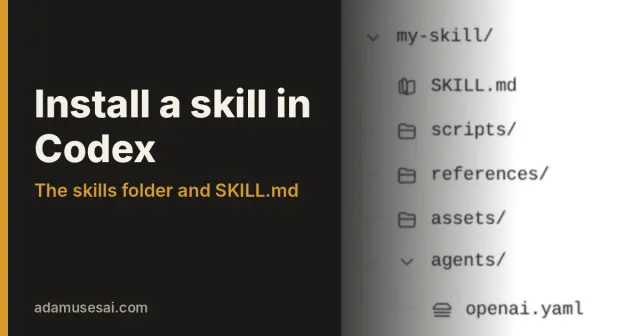 How to install a skill in Codex: folder, SKILL.md, invoking
 What is Claude Personal Finance: 4 limits and rules in US
 AI Skill Requirements: Plans, Apps and Hardware to Run Locally
 How You Get Your Files After Buying: 3 Steps to Download
 Use Your Own Brand Colors and Fonts: 6 Settings to Change
 What is Hermes Agent? 3 feature groups, open agent in 2026